
Your Pickleball Starter Kit: How to Actually Enjoy It
The gear, the etiquette, the shots — and the injuries — nobody warns you about before your first day on the court.
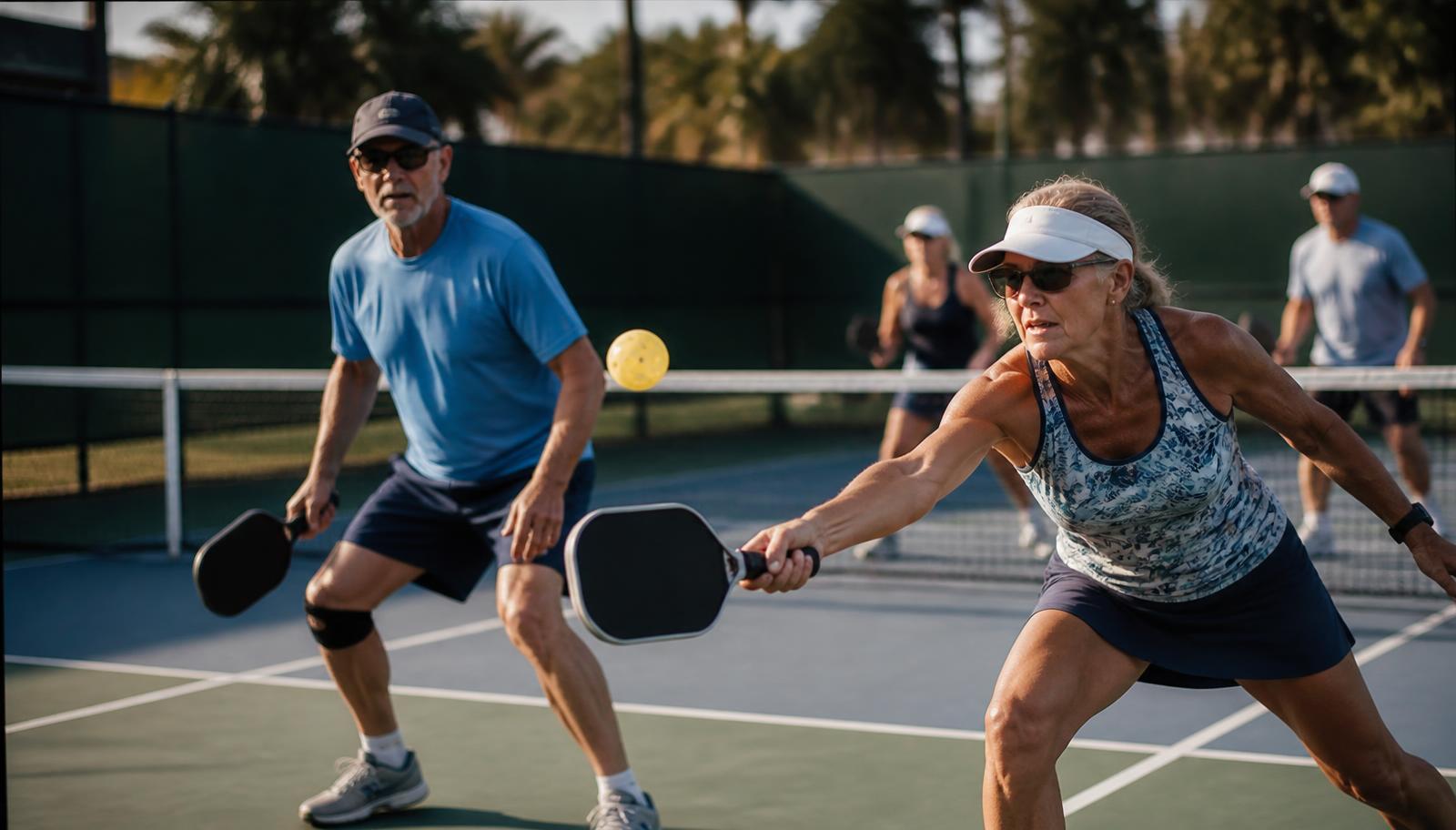
A friend of mine took up pickleball at 62. Two weeks in, he pulled his Achilles reaching for a lob and spent the next four months in a boot. His first words back at the courts: "I wish somebody had told me."
This piece is that somebody-had-told-me. Not a rulebook — you'll learn the rules in ten minutes on the court. What I want to give you is the stuff nobody explains before you show up: what gear actually matters, what the unwritten rules of open play are, how to avoid the injuries that sideline half of new players, and how to have fun from the very first hour instead of the third month.
Pickleball is the fastest-growing sport in America for a reason. It's social, it's learnable in an afternoon, and it's addictive in a way tennis and golf just aren't. But it also puts a middle-aged body through motions it hasn't done since high school gym class. Both of those things are true, and both matter.
Here's what I'd tell any friend who called and said they wanted to start playing next weekend.
Start with the right paddle (and don't overspend)
The single most common beginner mistake is walking into a sporting goods store and buying the cheapest paddle on the wall, or worse, the most expensive one. Both are wrong.
Here's the sweet spot for a first paddle:
- Weight: mid-weight, 7.5 to 8.2 ounces. Lighter feels fast in the store but gives you nothing to work with. Heavier tires out your arm and increases the risk of pickleball elbow.
- Core: polymer honeycomb, 16 mm thick. Softer feel, bigger sweet spot, more forgiving of off-center hits.
- Grip size: small hands go with 4", average with 4 1/8"–4 1/4", large with 4 3/8"+. A grip that's too small forces you to squeeze — which is exactly what causes tennis/pickleball elbow.
- Price: $60 to $120 gets you a paddle you'll be happy with for your first year. Do not spend $250 on your first paddle. You don't know your style yet.
The paddle doesn't make the player. It just prevents you from getting in your own way.
Shoes matter more than the paddle
This is the piece of advice I most wish more beginners heard. Do not play pickleball in running shoes. Running shoes are built for forward motion; pickleball is played sideways. That mismatch is one of the biggest causes of the ankle rolls and Achilles injuries that put beginners in a boot.
Buy actual court shoes — tennis or pickleball-specific. They have flat, wide soles designed to handle lateral movement without giving out under you. Any tennis-court shoe from a reputable brand will do. Expect $80–$140. It's the best injury-prevention purchase you can make.
The three things that actually make you a decent beginner
You'll pick up the rules quickly. Serve underhand, let it bounce once on each side, don't step into the "kitchen" on a volley. Simple. But there are three fundamentals that separate a fun-to-play-with beginner from one people politely rotate away from.
1. Learn to dink before you learn to smash
A dink is a soft shot that just clears the net and lands in the opponent's kitchen. It looks unimpressive. It is pickleball at higher levels. Beginners spend their first month trying to hit winners. Better beginners spend their first month learning to keep the ball low, slow, and in play. The player who dinks well beats the player who smashes hard — every time.
2. Get to the kitchen line as fast as you can
The team standing at the non-volley line wins the vast majority of points. As soon as your serve goes out or the return of serve is played, your job is to move forward to that line and stay there. Beginners hang back at the baseline because it feels safer. It's not. It's where points go to die.
3. Communicate with your partner
Doubles pickleball is a partner game. Call "mine" or "yours" out loud on shots down the middle. Talk between points. Nothing tanks a doubles pairing faster than silent confusion about who takes the middle ball — and nothing improves it faster than five words of communication.
The unwritten rules of open play
This is the part nobody warns you about. When you show up at a public court, there's a whole culture that goes beyond the game itself. Get it right and you'll be welcomed. Get it wrong and you'll get the cold shoulder without knowing why.
Paddle rotation
Most open-play courts use a paddle-stacking system. You stack your paddle in a queue — usually a rack or a fence — and when your turn comes up, you play the next game. You do not walk onto a court just because it's open. Watch how the locals do it for five minutes before you put your paddle in the queue.
Call your own score, and call it loud
Before every serve, the server calls out three numbers: their team's score, the opponent's score, and either 1 or 2 for server position. "Four–two–one." Say it clearly enough for everyone on court to hear. Beginners mumble it or skip it. Don't.
Rotate off after a game or two
The unwritten expectation in most open-play settings is that you play one game to 11 and rotate off, giving others a chance to join. Some courts play two. Sticking on a court game after game because you're winning is a fast way to become that beginner.
Play up when invited, but don't self-select
If a stronger group waves you onto their court, that's a gift — accept it, play your best, and be gracious. Do not, on the other hand, walk onto a court of visibly stronger players and add your paddle to their queue. Play your level. Get better. Get invited up.
Every pickleball court is a small community. Ninety percent of etiquette is: watch what the regulars do, then do that.
The injuries you actually need to plan around
This is the section I wish someone had put in front of my friend two months before he ruptured his Achilles.
Knees, ankles, and Achilles account for roughly 60% of all pickleball injuries.
The sport is played sideways, with sudden stops and quick pivots. Your body has to be ready for that. The five most common injuries — and how to avoid each:
- Achilles tendon rupture: the signature senior pickleball injury. Comes from a sudden push-off on a cold tendon. Never skip a warm-up. Ten minutes of dynamic movement before every session, without exception.
- Ankle sprains and falls: usually from backpedaling to chase a lob. Never backpedal. Turn sideways and shuffle. If you can't get there sideways, let the ball go. A lost point is cheaper than a broken wrist.
- Rotator cuff / shoulder strain: from repeated overhead motions and reaching. Warm your shoulders up specifically — arm circles, cross-body stretches — and if a lob is over your head, let your partner take it or let it go.
- Pickleball elbow (lateral epicondylitis): from gripping too tight and hitting off-center. Prevention is a mid-weight paddle, the right grip size, and consciously relaxing your grip between shots.
- Wrist and hip fractures from falls: most common in players with bone-density concerns. If you've been told you have osteopenia or osteoporosis, talk to your doctor first — pickleball isn't off-limits, but favor doubles and skip aggressive lateral chasing.
The one rule that prevents most serious injuries
If you feel a sharp pop, snap, or sudden pain — particularly in the back of the calf or ankle — stop playing immediately. Do not "walk it off." A ruptured Achilles is a surgery-and-boot situation, and playing on it makes the outcome dramatically worse.
The pre-game warm-up that actually works
Skip static stretching. Sports medicine has moved on from that for warm-ups. Do this instead, in this order, for about eight minutes:
- 2 minutes of walking or slow jogging around the court to raise your core temperature.
- 30 seconds each: leg swings (front-to-back, then side-to-side) on each leg.
- 30 seconds each: arm circles — small then large, forward then backward.
- One minute of side shuffles across the court and back. This rehearses the exact lateral motion you're about to do at speed.
- Five minutes of easy dinking with a partner at the kitchen line — warm-up disguised as practice.
It sounds like a lot. It takes eight minutes. And it will save you from most of the injuries in this article.
Your first day on the court: a quick checklist
- A mid-weight paddle (7.5–8.2 oz, 16 mm polymer core).
- Court shoes — tennis or pickleball, not running.
- A hat and sunscreen. Most public courts are outdoors and you'll be out there longer than you think.
- A water bottle. Dehydration is a top cause of calf cramps that lead to worse injuries.
- A willingness to say "I'm new" when you get to the courts. The community is genuinely welcoming to beginners who admit they're beginners. It is impatient with beginners who try to fake it.
The bigger idea
Every retiree I know who plays pickleball tells me some version of the same thing: it changed their week. Not because of the exercise, though that matters. Because of the community. Because of getting out of the house. Because of having something to look forward to on Tuesday and Thursday and Saturday morning.
That's the real reason to play. Not fitness. Not weight loss. Connection. A regular court crew becomes a set of friends, and a set of friends becomes a reason to keep showing up — to the court, and to the rest of your life.
Just show up smart. Warm up. Wear the right shoes. Watch the regulars. Say "I'm new." And go easy on your Achilles.
The rest takes care of itself.
This article is for general educational purposes only and is not medical advice. Consult your physician before beginning any new exercise program, especially if you have existing joint, heart, or bone-density concerns.
Share a line
Pass this one along
Pick a line, save the card, and send it to whoever needs to read it.
Your next step
Questions about your own retirement?
Talk it through with a licensed advisor on our team. Ask your questions, get straight answers, and leave with a clear place to start. No cost, no obligation, nothing sold on the call.
Run your own numbers
The Let’s Start tool
Prefer to try it yourself first? It’s a calculator that sets a retirement income target and shows how much savings could support it.
Open the Let’s Start →Advisory and insurance services are provided by licensed professionals; availability varies by state.
The Conversation
No comments yet. Tell us where we got it right — or where we're dead wrong.
Comments are for members — it keeps the spam out and the conversation honest.
Create a free account