
Starlink Mini for $16 a Month: What It Actually Does That Your Phone Cannot
An email is making the rounds: Starlink Mini Kit for $16 a month, then you own it. Before you click "Order Now," here is how it compares to the phone in your pocket — and who actually needs it.
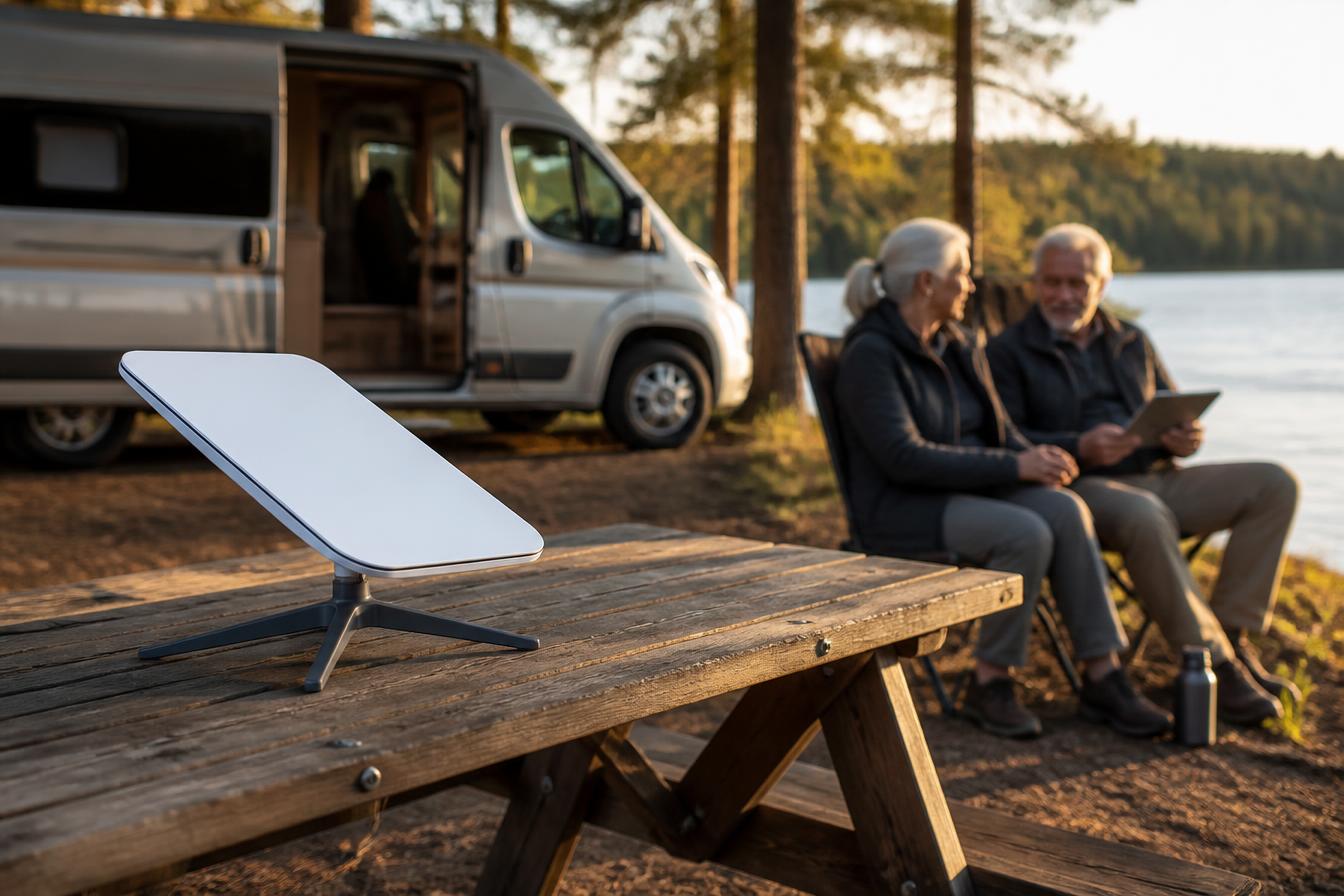
An email landed in a lot of inboxes this week: the Starlink Mini Kit for $16 a month for 12 months, then you own it. Service plans start at $55 a month. The pitch is irresistible if you have ever stared at a spinning wheel on your phone in a parking lot, a campground, or a weekend at the lake house.
But before you order, the honest question is: What does this thing actually do that your phone does not? Because the answer is not "better internet everywhere." It is more specific, more expensive, and more useful in some places than others.
What Starlink Mini actually is
Starlink Mini is a smaller, portable version of SpaceX's satellite internet dish. It connects to the same constellation of low-Earth-orbit satellites that regular Starlink uses, but the hardware is designed to be carried, stowed, and set up in a few minutes. It is aimed at people who want internet where cell towers do not reach or where they do not trust the cell towers to keep up.
The current offer breaks the hardware cost into $16 a month for 12 months. After that year, you own the dish. The service plan is separate — starting at $55 a month for the Roam plan, which is the one designed for travel, RVs, boats, and anywhere else you do not have a permanent address.
How it is different from your cell phone
This is the part that gets muddled in the marketing. Your phone and Starlink are not doing the same job. They are solving different problems with different hardware and different costs.
Coverage is not the same thing. Your phone connects to cell towers. If you are within a few miles of a tower, you are probably fine. Starlink connects to satellites overhead. It works in places where there is no tower at all — open water, remote campsites, rural roads, mountain passes, and the middle of a national park.
Speed is not the same thing either. A strong 5G signal can be faster than Starlink. A weak one-bar signal is useless. Starlink tends to be more consistent in remote areas because it is not fighting through trees and hills to find a distant tower. In a crowded stadium or downtown, your phone usually wins.
Data is where it gets tricky. Most unlimited phone plans are not truly unlimited for hotspot use. They throttle you, cap your hotspot data, or deprioritize you when the network is busy. Starlink Roam plans come with a set amount of high-speed data — check the current plan details before you buy — and you can usually add more. It is not unlimited in the "use it like home broadband" sense either.
Power and setup matter. Your phone fits in your pocket. Starlink Mini needs power, a clear view of the sky, and a few minutes to find satellites. It is not something you pull out at a traffic light. It is something you set up at a campsite, a dock, or a parked RV.
Who actually needs Starlink Mini
Here is the straight answer: most people do not. If your phone works fine at home, at the grocery store, and at your daughter's house, you are not the target.
The people who benefit are:
- RVers and van lifers who work or stream on the road and do not want to chase coffee shop Wi-Fi.
- Boaters who need connectivity offshore or at anchor beyond cell range.
- Second-home owners in rural areas where cable and DSL are slow or nonexistent.
- Remote workers who need reliable video calls from places cell service cannot reliably deliver.
- Preparedness-minded households that want a backup internet option for outages.
For everyone else, the phone in your pocket — plus the hotspot you already pay for — is probably enough.
The real cost, beyond the $16
The headline is $16 a month. That is the hardware. After 12 months, you own the kit. But the service is what keeps it working, and that is $55 a month and up.
So the first-year math is roughly $16 for hardware + $55 for service = $71 a month, or about $852 for the year. After you own the hardware, you are still paying for service if you want to keep using it.
Compare that to your phone plan. If you already have unlimited data and hotspot capability, your marginal cost for occasional off-grid internet is $0. Starlink only saves money if you are currently paying for multiple workarounds — campground Wi-Fi, extra data plans, or unreliable DSL at a second home.
Is it worth it?
Yes, if you are frequently in places where your phone is not enough. No, if you are mostly around towns and suburbs with decent cell coverage.
The Starlink Mini is a specialty tool, not a replacement for your phone. It is a great specialty tool for the right person. If you are the kind of traveler who gets twitchy when the map says "No Service" for 40 miles, it is worth a serious look. If your biggest complaint is that the bar loads slowly at the gym, keep your money.
Prices and promotions change. This article is based on an active Starlink offer as of publication. Check Starlink's current site before ordering — and run the math on your own data usage and travel habits.
Share a line
Pass this one along
Pick a line, save the card, and send it to whoever needs to read it.
Your next step
Questions about your own retirement?
Talk it through with a licensed advisor on our team. Ask your questions, get straight answers, and leave with a clear place to start. No cost, no obligation, nothing sold on the call.
Run your own numbers
The Let’s Start tool
Prefer to try it yourself first? It’s a calculator that sets a retirement income target and shows how much savings could support it.
Open the Let’s Start →Advisory and insurance services are provided by licensed professionals; availability varies by state.
The Conversation
No comments yet. Tell us where we got it right — or where we're dead wrong.
Comments are for members — it keeps the spam out and the conversation honest.
Create a free account